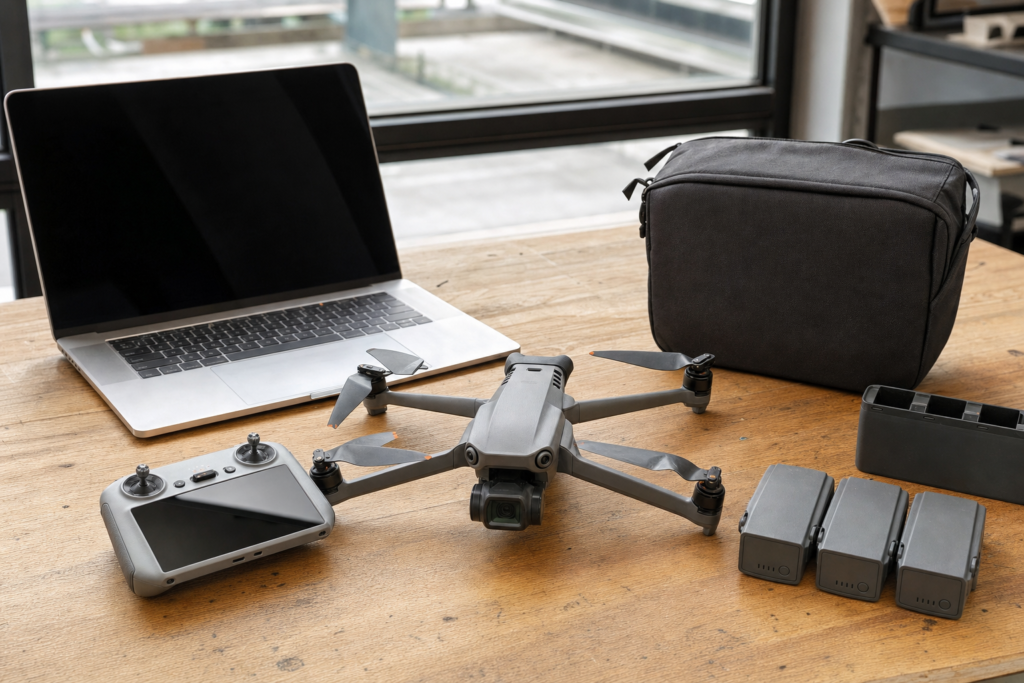
You have a drone you no longer fly, and where you sell it can change what you take home by a lot. The easiest route is rarely the best-paying one. Here is how the main options compare and how to match one to your drone’s condition.
The four routes at a glance
| Route | Payout | Speed and hassle | Watch for |
|---|---|---|---|
| Retailer trade-in or buyback | Lowest cash; credit can be higher | Fastest, least effort | Re-inspection can cut the quote |
| Private sale (marketplace or local) | Usually the most | Slower; you deal with buyers | Platform fees vary widely |
| Local shop consignment | Depends on the shop | Moderate | Terms vary, so ask |
| Parts-out or sell as broken | Sum of salvageable parts | Depends on how you list | Same platform fees apply |
Trade-in and buyback: fast, but you pay for the convenience
People use these words loosely, but they are different products. A trade-in gives you store credit toward new gear. A buyback pays cash with no purchase required. One 2026 guide says buyers typically pay roughly half of the used resale price in cash, and up to about 70% as store credit for clean, current models. A reseller quoted there put it plainly: a drone that sells used for $500 might draw an offer of about $250 to $300.
The same guide cites a September 2025 Adorama offer on a DJI Mavic 3 Pro: $1,750 cash or $1,900 in store credit, when a new one ran about $1,850 to $2,000. It called that a fair deal. Not every offer is. It also describes a case where DJI’s trade-up tool quoted a Mavic at $275.60, then cut the offer to $41 after re-inspection. Describe your drone’s condition honestly, because a quote is only as firm as the inspection that follows.
Programs also come and go. A 2018 DJI support answer said no trade-in program was planned, and the 2026 guide advises confirming that any DJI program is live and covers your model before counting on it. It also says Best Buy pays out as an e-gift card and that B&H’s used department does not buy drones. Check each retailer’s current page first.
Private sale: the best payout, with fees that differ
Selling directly to a buyer nets the most money by a wide margin, according to the trade-in guide, at the cost of time and some hassle. A reseller-focused guide lists average sell times of 5 to 21 days, though yours will depend on price, model and season.
Fees are where the options diverge:
- eBay: a final value fee of about 13.25% on electronics, charged on item plus shipping.
- Facebook Marketplace: no platform fee on local pickup. Shipped orders through checkout run 5%, or $0.40 minimum.
- GearFocus: 8.5% total, so sellers keep 91.5%.
- Swappa: a flat 3% seller fee, plus payment processing (PayPal at 3.49% + $0.49, or Stripe at 2.9% + $0.30 for select sellers). Drones must be fully functional and meet Swappa’s listing requirements.
- DroneTrader: no commission. A free member can post one ad, and unlimited ads cost $7 a month or $19 a year. You handle the conversation and payment yourself.
Fee schedules change, so confirm each platform’s current terms before listing.
Shipping deserves thought. Carriers treat lithium batteries differently depending on whether they are installed, packed with equipment, spare, used, damaged or going abroad. For multi-battery kits, local pickup is often the simplest path. If you ship, follow your carrier’s rules and the manufacturer’s battery guidance.
Consignment at a local shop
Consignment terms vary from shop to shop, so there is no typical payout to quote here. In general, a shop sells the drone for you and keeps a share. Ask what the commission is, how long the drone stays on the shelf, who is responsible if it is damaged there, and when you get paid. Then compare the shop’s terms with your own private-sale math after fees.
Broken drone? Check before you part it out
A damaged drone is rarely worth zero. Buyers of crashed drones price the components, and the most valuable are usually, in rough order:
- Intelligent batteries, often the biggest price lever
- An intact camera and gimbal
- The remote controller, especially screen-equipped ones
- Main boards and sensors, which repairers want
- Motors, arms, shells and props, worth less each, though a complete parts drone beats a stripped one
First, work out whether it is truly dead. Snapped props, a scuffed shell and a jammed gimbal are usually cheap fixes. A cracked main board, water damage or a bent motor arm is more serious. If repair costs less than the value you would lose selling it broken, fixing it first may pay more. Also check whether you have an active DJI Care Refresh plan or similar coverage, since a flat replacement fee may beat selling a wreck. Opening the airframe or handling a damaged lithium battery belongs with a qualified repair shop or the manufacturer’s service, not a DIY fix.
Before you hand it over
- Unbind and reset. On DJI drones, open the DJI Fly app, go to your profile, then Device Management, select the aircraft and choose Unbind Device. Then factory reset the drone, which clears your flight logs. Other brands follow a similar pattern in their own apps. A buyer may treat a drone as high risk or parts-only if the seller cannot show the unbind.
- Bundle everything. Extra batteries are the biggest lever on resale price. Add the controller, charger, props, filters and case. Missing basics tend to cost more than their replacement price.
- Write down serial numbers. Note the aircraft, each battery and any separate Remote ID serial. A buyer registering the drone may need the make, model and Remote ID serial.
- Photograph honestly. Clean it, shoot every angle and disclose crashes and repairs.
- Price against real comps. Look at what the same model with the same accessories actually sold for, not at asking prices.
Registration and Remote ID requirements depend on a drone’s weight and how it is used, so confirm current rules with the FAA, and check any state or local rules that apply to you.
How to choose
If your drone is recent, clean and complete, and you plan to buy new gear from the same retailer, get a trade-in quote and compare it with a private-sale estimate after fees. If you want it gone this week, take the cash buyback and accept the discount. If you have time and a full kit, list it yourself, ideally for local pickup. If it is broken, price the repair first, then the parts.
Whichever route you pick, get two or three quotes and do the fee math before you commit.
Featured image: AI-generated illustration
Footnotes & Sources
- Drone Trade-In: Where to Trade Your Drone in 2026, DroneTrader Blog, August 23, 2026. — Trade-in vs buyback definitions, cash and credit percentages, reseller rule of thumb, Adorama Mavic 3 Pro example, DJI re-inspection case, Best Buy e-gift card, B&H not buying drones, advice to confirm DJI program status, private sale pays most.
- Trade In, DJI, November 27, 2018. — 2018 DJI statement that no trade-in program was planned.
- DJI Drone Flipping Guide: Test, Price, Ship & Avoid Locks, Underpriced, July 18, 2026. — Average sell time, lithium shipping categories, local pickup advice, FAA registration and Remote ID depending on weight and use, account-unbinding risk, kit completeness.
- Broken Drones for Sale 2026: Up to 70% Off Retail, DroneTrader Blog, July 29, 2026. — eBay and Facebook Marketplace fees, valuable parts in crashed drones, repair-versus-sell and Care Refresh guidance.
- Sell Used DJI Neo: Timing Your Sale After the Neo 2 Launch, gearfocus.com, October 31, 2026. — GearFocus 8.5% total fee.
- How to Sell a Used Drone, swappa.com, October 17, 2026. — Swappa seller fee, payment processing fees and functional-drone requirement.
- Where to Sell Your Drone in 2026: Best Places Ranked, DroneTrader Blog, July 1, 2026. — DroneTrader pricing and model, unbind and reset steps, bundling, serial numbers, disclosure and comps advice.

Leave a Reply